


If you use a vehicle for business, keeping clear records is essential. It helps you claim expenses correctly and supports your tax filings if questions arise. This guide explains how logbooks work and how to track vehicle use in a simple and practical way.
Why a Logbook Is Important
A logbook provides reliable proof of how much you use your vehicle for business. Without it, your expense claims may be limited or questioned. By keeping accurate records, you can show exactly how your vehicle supports your business activities.

You can only deduct expenses that are reasonable and supported by receipts. Along with this, you must track how many kilometres you drive in total and how many of those are for business purposes.
Full Logbook Method
What to Record
A full logbook requires you to record every business trip throughout the year. Each entry should include the date, destination, purpose of the trip, and the number of kilometres driven. These details create a complete picture of your business use.
At the start and end of the fiscal year, you also need to record the odometer reading. If you change vehicles during the year, note the date of the change and the odometer reading at that time.
When to Use It
You must keep a full logbook for a continuous 12 month period. This becomes your base year. It is used to measure and compare business use in future years.
Simplified Logbook Method
After completing a full year logbook, you may choose a simpler approach. Instead of tracking every trip again, you can record a sample period of three months and use it to estimate your business use for the entire year.
This method only works if your usage remains similar to the base year. The difference must stay within ten percent. If the change is larger, the estimate will not be accepted.
How Business Use Is Calculated
To estimate annual business use from a sample period, the following formula is used:
(Sample year period % ÷ Base year period %) × Base year annual % = Calculated annual business use
Example Calculation
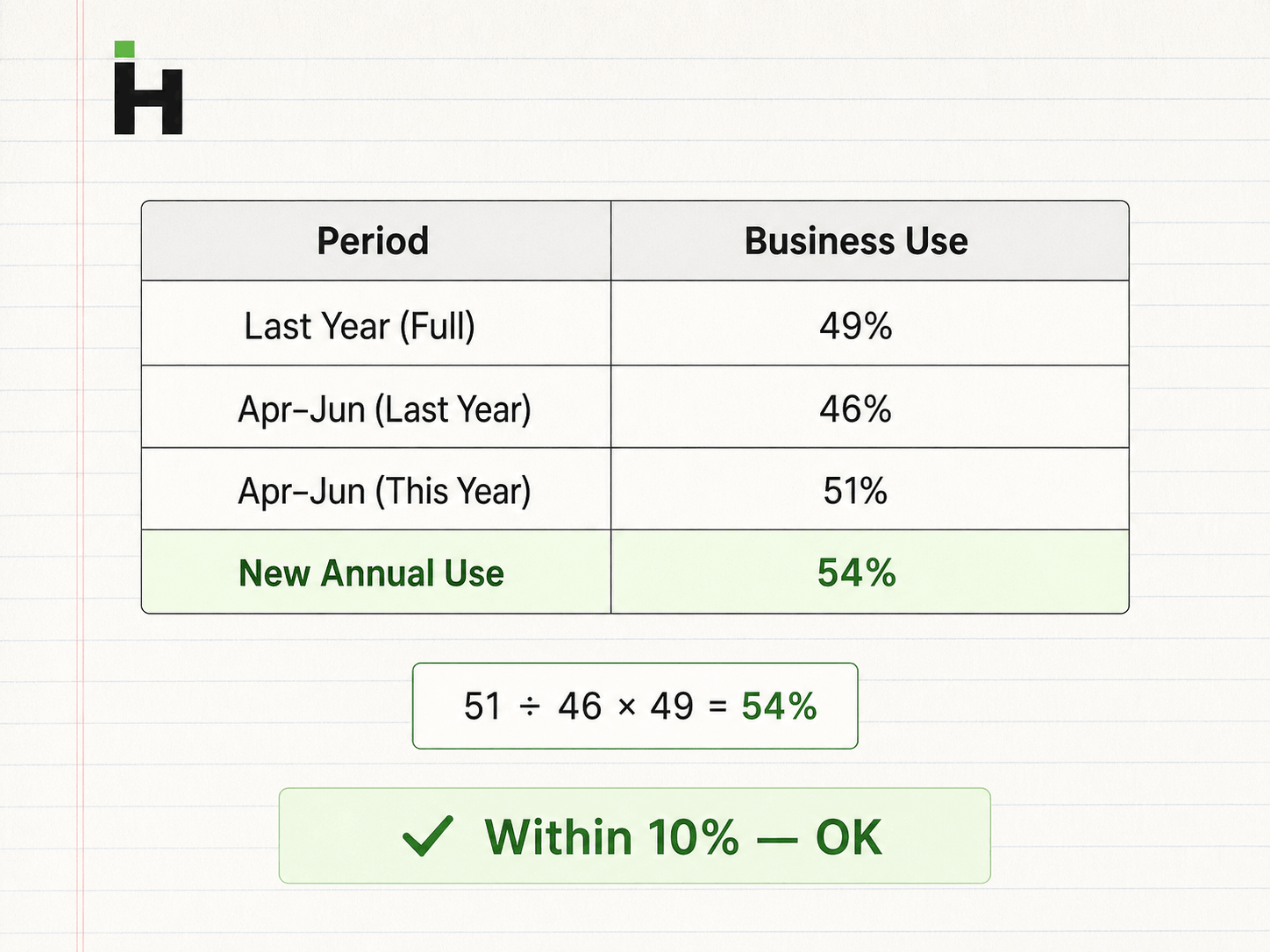
Consider a case where a full year logbook shows an annual business use of 49 percent. During that year, the business use for April, May, and June was 46 percent.
In the following year, a three month sample for the same period shows 51 percent business use.
To calculate the new annual percentage, divide 51 by 46 and multiply the result by 49. This gives a final business use of 54 percent.
This result is acceptable because it remains within ten percent of the base year. If it had fallen outside that range, the simplified method could not be used for the full year.
When the Simplified Method Cannot Be Used
If your business use changes significantly, the base year no longer reflects your normal driving pattern. In that situation, a three month sample is not enough to estimate the full year.
You would then need to keep detailed travel records for the entire year or create a new base year by maintaining a full logbook again.
Record Retention
All records must be kept for six years from the end of the tax year they relate to. The base year logbook must also be kept for six years from the last year it is used for comparison. This means it may need to be stored longer than other records.
Using More Than One Vehicle
If your business uses multiple vehicles, each one must be tracked separately. You need to record the total distance driven and the business portion for each vehicle. Expenses should also be calculated individually rather than combined.
Practical Tips
Keep your logbook updated as you go instead of trying to fill it in later. Store receipts in one place so they are easy to access when needed. Choose a consistent method each year unless your usage changes enough to require a new base year.
Conclusion
Maintaining a proper motor vehicle logbook ensures your expense claims are accurate and supported. Starting with a full year record gives you a reliable base and allows you to simplify your tracking in later years, as long as your usage stays consistent.